 PuckFit
Bottomless portafilter spraying? A step-by-step diagnosis
Quick answer: A spray from underneath a single-wall basket often points to uneven flow. A leak around the rim is a different problem. Start by locating the water, then change one thing at a time.
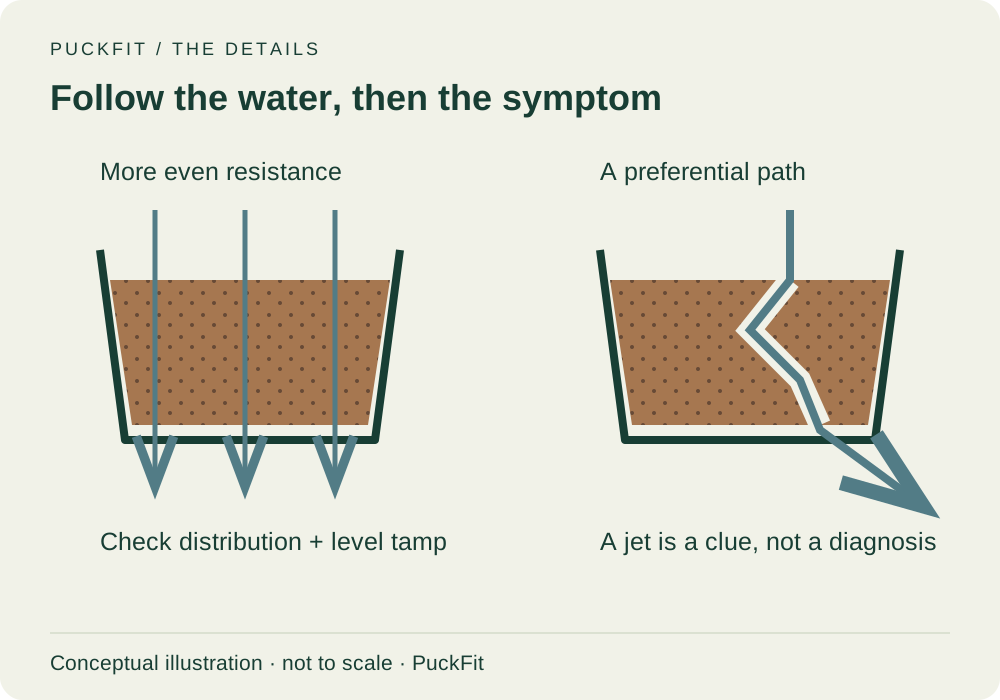
First, identify where the spray starts
Clive Coffee demonstrates how a weak path through the coffee can produce a jet under a bottomless basket. The exposed basket makes the symptom visible; changing the handle alone does not correct the coffee bed. Breville also distinguishes a single-wall basket from a dual-wall basket with a restricted outer outlet. Identify which basket you are using before interpreting its flow.
| What you see | Check next |
|---|---|
| Fine jets from the basket holes | Distribution, tamp alignment and grind setting with a single-wall basket. |
| Water escaping around the basket rim | Clean rim, correct seating and the machine's seal instructions. |
| A concentrated stream from one outer outlet | Whether the basket is dual wall; its outlet is designed differently. |
| Splash only when coffee hits the cup | Cup position and distance, before changing the recipe. |
Use a short, repeatable investigation
The following sequence is PuckFit's practical troubleshooting framework. It keeps a new basket, new beans and a new tamping routine from becoming three unknowns at once.
- Record the starting point. Note the basket model, beans, coffee dose, beverage weight and grind setting. Keep the same cup and cup position. Photograph the basket label if identifying it is difficult.
- Start with a clean basket. Check the underside and rim after the machine has cooled. Follow the maker's cleaning instructions if holes appear blocked. Do not enlarge holes or modify a pressurized basket.
- Even out the loose coffee. Look for an obvious mound or clumps before tamping. Our WDT sequence explains one way to distribute the grounds through the bed.
- Tamp level. Support the portafilter so it does not rock and withdraw the tamper without knocking the basket. Keep this routine the same for your next comparison.
- Make the next change deliberate. If you adjust grind, keep the measured dose and target beverage weight fixed. Write down what changed in the cup as well as underneath the basket.
When a tool is worth considering
Use a purchase to address an identified limitation. Uncertain dimensions call for a basket and tamper fit check. Difficulty holding the tamper level calls for examining your support and technique before comparing self-leveling designs. A repeatable click cue is a separate preference, covered in our Flash 2.0 buying guide.
A neat-looking stream is useful feedback, but it is not an extraction measurement. Avoid rating every shot by a video alone. Compare taste, beverage weight and repeatability; keep the successful recipe rather than buying several accessories to hide a symptom.
Does spraying prove the bottomless portafilter is defective?
No. First distinguish a jet through the basket from a leak at the group seal. If the portafilter does not lock normally, stop and check model compatibility with the supplier.
Should I tamp harder to stop every spray?
Extra force does not identify the cause. Work through the basket, distribution and alignment checks, then use the tamping-pressure guide to make your routine repeatable.
Sources and scope
The sources below support the technical explanations. Checklists and buying decisions are PuckFit's editorial guidance. Illustrations explain concepts and are not product test photographs.
- Clive Coffee: espresso channeling (editorial source · non-affiliate) — checked 10 November 2026.
- Breville: pressurized and non-pressurized baskets (editorial source · non-affiliate) — checked 10 November 2026.