 PuckFit
How hard should you tamp espresso? Level, firm and repeatable
Quick answer: Tamp with a level base until the grounds stop settling under a comfortable, firm press. Keep the routine repeatable instead of using a harder or softer tamp to dial in every shot.
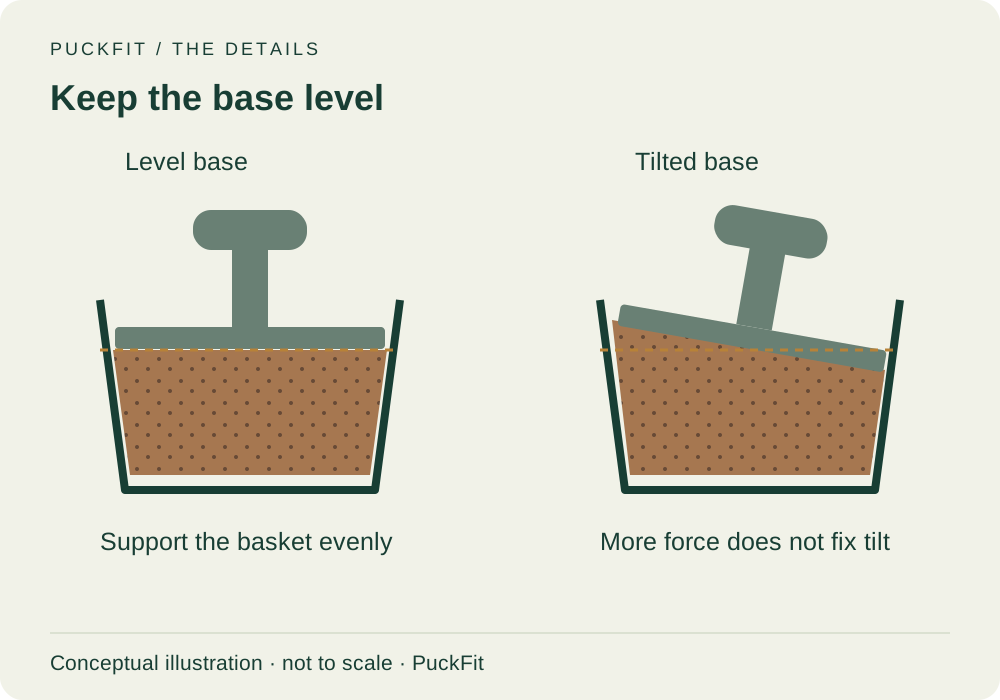
Is 30 pounds the correct pressure?
A number printed on a spring tamper is a product specification, not a universal recipe. Barista Hustle's practical advice is to compress the bed until it stops moving and keep the base horizontal. Its tamping lesson also separates a snug fit from a tamper that becomes lodged in the basket.
The useful distinction is between force, alignment and fit. A force cue does not prove the base stayed level. A leveling collar does not prove the base reaches the coffee at your chosen dose. And neither feature establishes compatibility with a different basket.
A routine you can inspect
- Support the portafilter. Set it on a suitable stable tamping surface. Check that the basket is level rather than assuming the handle lies flat.
- Look at the coffee before pressing. If one side is heaped up, redistribute the loose grounds first. Tamping is not a substitute for that step.
- Place the base squarely. Look from two directions if you are learning. A tilt that is hard to see from the front may be obvious from the side.
- Use one controlled press. Follow the tool's instructions and stop once the bed has settled. There is no benefit to turning this into a maximum-strength exercise.
- Lift and inspect. Withdraw without knocking the basket. If the surface has been lifted or torn, investigate that issue before changing your grinder.
Our practical suggestion for learning is to practice the sequence slowly for a few preparations, then compare your notes. Do not change the dose, grind setting and pressing style together; otherwise a better cup will not tell you which change helped.
Manual, spring-loaded or self-leveling?
| Feature | Reason to consider it | Still check |
|---|---|---|
| Simple manual tamper | You are comfortable with its handle and can repeat the motion. | Base fit and alignment. |
| Spring or click cue | You prefer feedback during the press. | Maker's operating method, usable travel and exact variant. |
| Leveling collar | You want a reference against the basket rim. | Whether the base reaches your coffee bed and the collar sits properly. |
If your current tamper fits and is comfortable, a new force number is not a reason by itself to replace it. If you specifically want a spring cue, our Flash 2.0 buying guide shows the manufacturer photos, compatibility limits and variant checks. Read those checks before using the purchase link below.
What if the shot is still fast or slow?
Barista Hustle recommends controlling flow with grind adjustment rather than repeatedly varying tamp pressure. Keep your dose, target beverage weight and tamping sequence recorded while evaluating a grind change. A shot that looks wrong after a new basket also calls for identifying that basket, not automatically pressing harder.
Does a calibrated tamper guarantee better espresso?
No. It may provide a cue you like, but this guide does not establish a measured improvement in taste, force accuracy or durability for a particular product.
Should I polish the puck with a big twist?
A decorative finish is not the goal of this routine. Follow the tool's instructions and prioritize leaving the prepared bed undisturbed when withdrawing.
Sources and scope
The sources below support the technical explanations. Checklists and buying decisions are PuckFit's editorial guidance. Illustrations explain concepts and are not product test photographs.
- Barista Hustle: How Hard Should You Tamp? (editorial source · non-affiliate) — checked 10 November 2026.
- Barista Hustle: Tamping mechanics (editorial source · non-affiliate) — checked 10 November 2026.