 PuckFit
Espresso tamper sticking to the puck: residue, fit or lifting?
Quick answer: A few grounds on the tamper base are different from a puck that lifts or a base that jams. Identify which one you have, then check cleanliness, clearance and withdrawal separately.
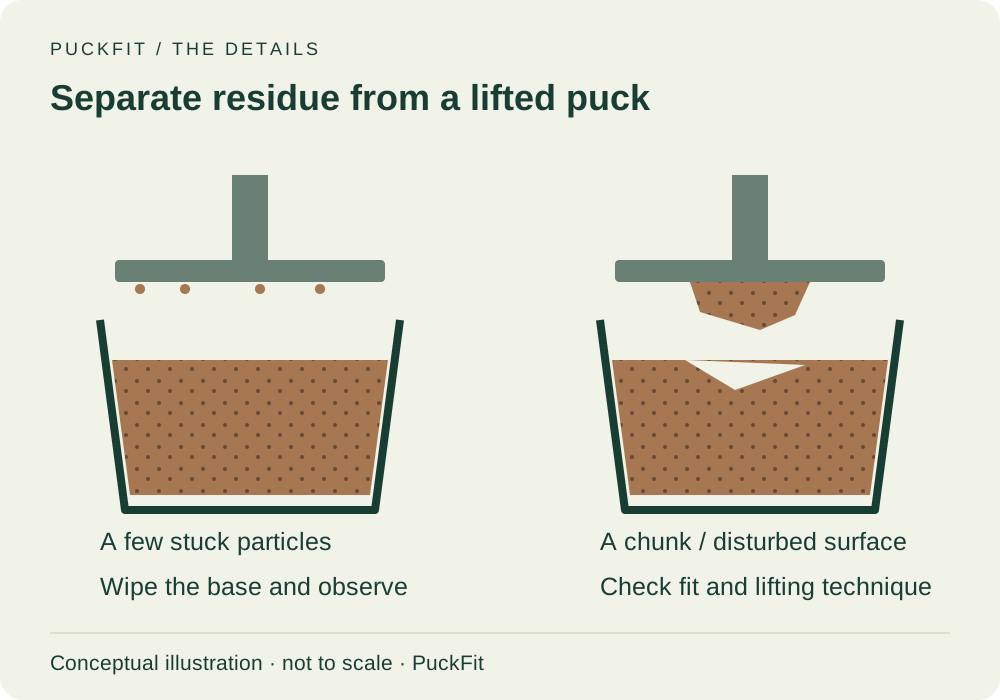
Which kind of sticking is happening?
A dusting on the base, a torn patch on the puck and a tool physically wedged in a basket are different observations. Start with a clean tool and an empty, cool basket to distinguish clearance from coffee residue. Never force an oversized base down a tapered basket.
Barista Hustle attributes sticking to interactions involving coffee oils, moisture and the tamping surface. Its explanation notes that a coating does not eliminate the problem and that a very small residue is different from a significant disturbance to the bed. This is a reason to inspect the symptom before buying an “anti-stick” replacement.
Try these checks in order
| Observation | Next check |
|---|---|
| A thin film or a few particles on the base | Wipe the base with a clean suitable cloth and compare the next preparation. |
| A chunk lifts out with the tamper | Check the base surface, dampness and how you withdraw the tool. |
| The tool catches even in an empty basket | Stop. Confirm the actual base diameter and basket recommendation. |
| Sticking began with a replacement basket | Compare the new basket's shape and recommended dimensions. |
| The brewed puck sticks to the machine above | That is a shower-screen/headspace question, not tamper residue. |
Our suggested comparison is deliberately simple: keep the same beans, basket and dose, clean the base, then prepare again. If the problem persists, inspect the hardware separately. Avoid testing several withdrawal tricks while also changing the grind; you will lose the clean comparison.
- Clean according to the tool's instructions. Inspect the base edge for visible damage or rough deposits. Do not sand a precision base or immerse a spring mechanism unless its maker permits it.
- Keep preparation surfaces dry. Breville's Duo-Temp Pro instructions explicitly start dosing with a dry basket. A recently rinsed basket deserves a drying check before the next dose.
- Check clearance without coffee. A close fit should not mean forcing metal against the basket wall. Our fit guide explains why the nominal system size and base diameter are different labels.
- Withdraw in a controlled motion. Lift without dragging the base across the surface or levering against the basket. Observe what remains rather than assuming every particle is a failed preparation.
When should you replace the tamper?
A wrong size, damaged base or uncomfortable handle is a concrete reason to investigate a replacement. A small amount of residue that clears with routine wiping is a different buying decision. Document the issue you want a new tool to solve and compare that requirement with the specification.
For spring-loaded options, inspect both the base and the mechanism instructions. The Flash Tamper 2.0 guide includes manufacturer close-ups and sizing limits; it does not claim that the product eliminates sticking.
Does a non-stick coating mean I never need to wipe the base?
No. Barista Hustle's discussion still identifies cleaning as relevant with coated tools. Follow the maker's care instructions and avoid abrasive cleaning.
Should I buy a bigger base to stop coffee sticking?
Not without checking the basket. A bigger diameter can introduce a clearance problem. Choose dimensions using the actual basket specification, not the appearance of leftover coffee.
Sources and scope
The sources below support the technical explanations. Checklists and buying decisions are PuckFit's editorial guidance. Illustrations explain concepts and are not product test photographs.
- Barista Hustle: why coffee grounds stick to tampers (editorial source · non-affiliate) — checked 10 November 2026.
- Breville Duo-Temp Pro instruction book: coffee dose and tamping (PDF) (editorial source · non-affiliate) — checked 10 November 2026.