 PuckFit
Puck screen dose and headspace: why your portafilter feels too tight
Quick answer: A puck screen sits above the tamped coffee and occupies some of the space below the machine's shower screen. If the portafilter suddenly feels too tight, stop and recheck the setup rather than forcing it into place.
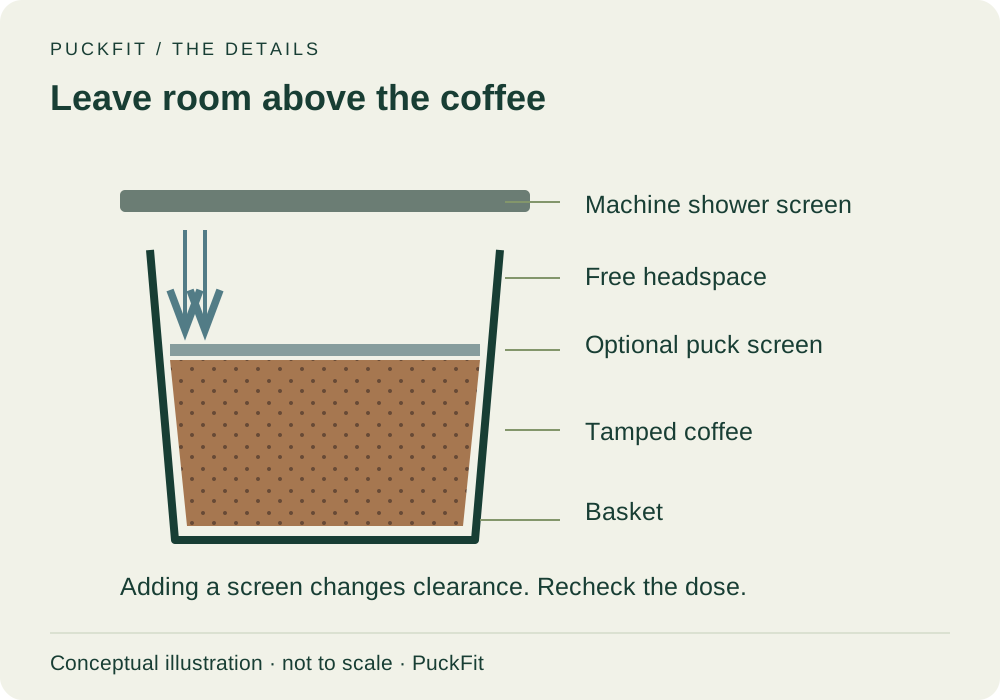
Two screens, two different parts
The machine's shower screen distributes water from the group head. A removable puck screen is an accessory placed on the coffee. They are not interchangeable parts, and a puck screen does not remove the need to clean the machine's shower screen.
Normcore's instructions acknowledge that a very full basket may need a smaller dose with its screen. That is product-specific guidance, not a conversion formula for all screens. Barista Hustle discusses headspace as one of the variables affected by dose and basket geometry. Together, these sources support checking the complete combination instead of selecting an accessory by machine name alone.
A clearance check you can repeat
- Identify both dimensions. Record the screen's diameter and thickness, as well as the basket model. A listing may offer several thicknesses under one product title.
- Start from a known recipe. Note the coffee dose and whether the portafilter previously seated normally without the accessory. Use the same basket and coffee for the comparison.
- Confirm that the screen sits correctly. It should lie in the position specified by its maker without being wedged against a tapered wall. Keep the basket rim clean.
- Check the fit gently before brewing. If normal locking now needs extra force, stop. Review the dose, basket, accessory thickness and the machine's guidance; forcing the handle is not a clearance test.
- Reassess after a deliberate change. If you alter dose within the basket's suitable range, record it and dial in again. Do not assume the previous recipe remains identical.
How many grams should you remove?
There is no reliable universal “one gram per millimetre” rule. Coffee mass, the height of the prepared bed and the shape of the basket are different quantities. A particular screen instruction may give a starting suggestion, but it does not establish the remaining space in your machine.
Our practical decision is to avoid turning an accessory into a reason to use an unsuitable dose. If a screen cannot fit while preserving a sensible recipe, investigate another compatible thickness or use the basket without it. The original working setup gives you a useful comparison.
| Issue | Investigate |
|---|---|
| Screen will not lie flat | Diameter, basket taper and debris. |
| Handle is harder to lock than before | Added thickness and available clearance; do not force it. |
| New recipe tastes worse | Compare dose, output and grind with the previous setup. |
| You mainly want easier cleanup | Decide whether cleaning and handling the extra part is worthwhile. |
Before buying another accessory
Choose by the actual basket and the screen specification. Do not copy a generic size chart across every Breville or Sage model: machines from one brand can use different systems. A tamper diameter is also not automatically the right puck-screen diameter.
PuckFit has not tested extraction gains from these screens. This guide addresses fit and a decision process. If your only concern is a wet spent puck, first read why a soggy puck is not a taste test.
Should I tamp the screen into the coffee?
Use the accessory as its maker specifies. This guide describes placing a removable screen above a prepared bed, not forcing it into the coffee to create clearance.
Can a post-brew mark tell me the exact gap?
No. Treat an imprint as an observation to investigate, not a precise measurement of the clearance before brewing. Check the setup and the relevant manufacturer guidance.
Sources and scope
The sources below support the technical explanations. Checklists and buying decisions are PuckFit's editorial guidance. Illustrations explain concepts and are not product test photographs.
- Normcore: espresso puck screen specifications and use (editorial source · non-affiliate) — checked 10 November 2026.
- Barista Hustle: dose, bed depth and headspace (editorial source · non-affiliate) — checked 10 November 2026.