 PuckFit
Breville Bambino soggy puck: what to check before changing dose
Quick answer: A wet puck on a Bambino or Bambino Plus does not, by itself, mean the espresso is bad. Check what is in the cup and identify the actual basket before increasing the dose.
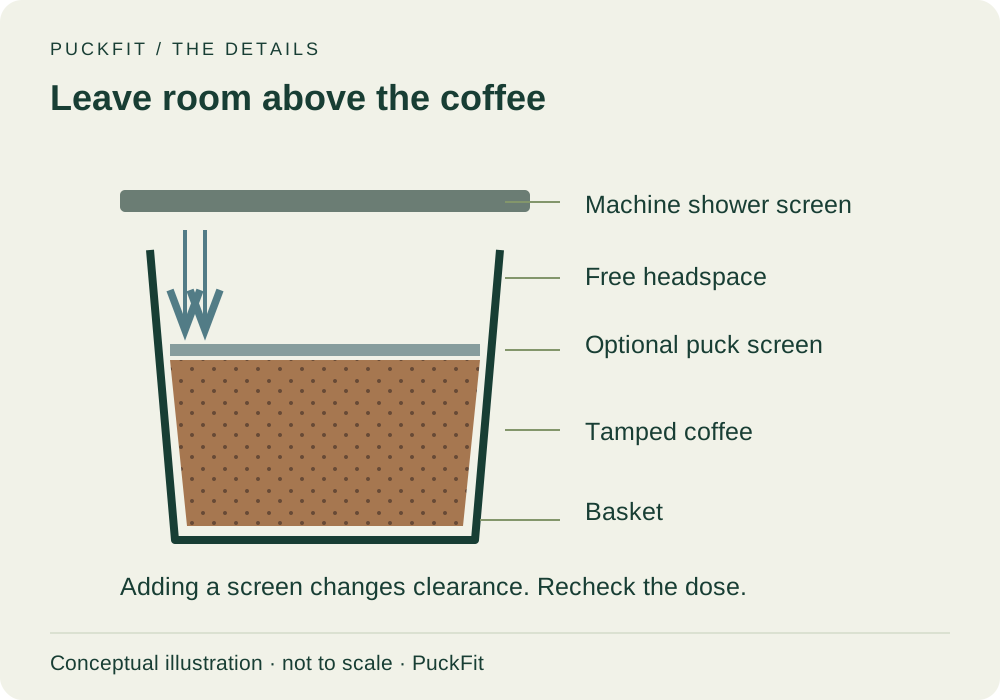
Separate appearance from a brewing problem
Barista Hustle explains that water remains around and within the coffee after brewing; a larger gap above the coffee can leave a wetter spent puck. Puck dryness is therefore not a standalone measure of extraction. That explanation is general, not a statement that every espresso machine drains in the same way.
Keep the Bambino and Bambino Plus model names separate. This article cites the BES500 Bambino Plus manual for its basket guidance; it is not a service manual for the BES450 Bambino. Use the booklet for your exact model when checking cleaning procedures or post-brew behavior.
Make a small record before changing anything
Our suggested worksheet takes less than a minute: basket identity, coffee weight in, beverage weight out, approximate shot duration and a brief taste note. Also note any new beans, replacement basket or puck screen. These details give you a useful comparison if the puck suddenly looks different.
| Situation | A useful next step |
|---|---|
| You enjoy the espresso; only the puck looks wet | Keep the recipe. Handle cleanup according to your machine instructions. |
| The basket was recently replaced | Use the replacement maker's dose and fit guidance. |
| A puck screen was added | Recheck clearance before trying more coffee. |
| Taste and flow also changed | Compare the recorded recipe and change one variable. |
| There is unexpected pressure, leakage or unusual machine behavior | Stop and consult the exact model's troubleshooting instructions or support. |
What about 18 grams in a Bambino Plus?
The cited Bambino Plus manual lists 16–19 g for its supplied 2 CUP basket. Treat that as guidance for those supplied baskets, not a universal capacity for every basket sold as 54 mm. A new basket should be identified by its own specification, and a screen added above the coffee changes the available room.
As an example of a useful record, “18 g in, 36 g out, basket unchanged” tells you more than “the puck was soggy.” Those numbers are an illustration of record keeping, not a prescription for every coffee. If you choose to alter the dose, write down the new value and reassess the beverage rather than making dryness the target.
Do you need a new tamper?
A wet puck alone does not identify a tamper problem. Before shopping, check whether the existing tamper enters the basket freely, whether the dose is repeatable and whether there is a specific comfort or alignment issue. The upgrade decision guide helps separate those reasons.
Do not apply a generic backflushing tutorial to an unidentified machine. Never loosen the portafilter during brewing, and follow your model's instructions for pressure release and safe removal. A change in machine behavior deserves its own diagnosis instead of being covered up with a larger dose.
Should I add coffee until the puck comes out dry?
No. Use the basket's appropriate dose and check clearance. A tidy spent puck is not a good reason to sacrifice a recipe you enjoy.
Will a puck screen solve this automatically?
No. It adds another part and takes up space. Read the puck screen and headspace guide before fitting one to an already full basket.
Sources and scope
The sources below support the technical explanations. Checklists and buying decisions are PuckFit's editorial guidance. Illustrations explain concepts and are not product test photographs.
- Barista Hustle: For a Good Puck (editorial source · non-affiliate) — checked 10 November 2026.
- Breville Bambino Plus BES500 instruction book (PDF) (editorial source · non-affiliate) — checked 10 November 2026.