 PuckFit
Pressurized vs non-pressurized espresso baskets: which should you use?
Quick answer: Start with your coffee and grinder. A pressurized basket uses a restricted outlet; a non-pressurized basket relies more directly on the prepared coffee bed. The portafilter handle and the basket are separate parts.
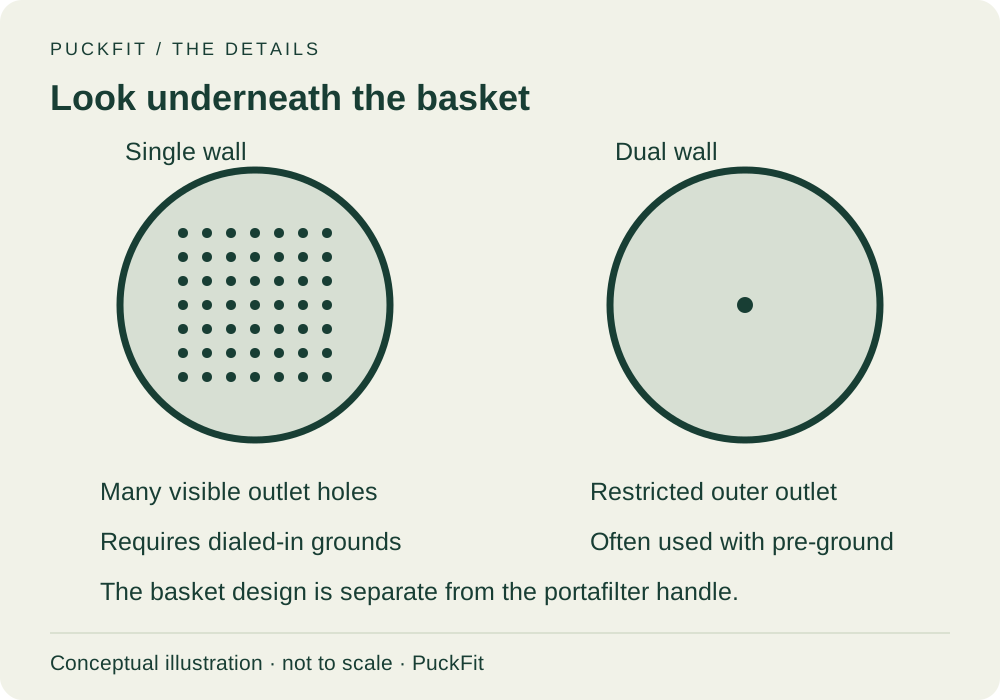
Identify the basket from underneath
Breville describes a pressurized, or dual-wall, basket as having an inner perforated wall and an outer wall with a much more restricted outlet. A non-pressurized, or single-wall, basket has many holes through its base without that extra outer restriction. Inspect an empty, cool basket and check its markings or manual if uncertain.
A bottomless portafilter exposes the basket's underside. It does not turn a dual-wall basket into a single-wall design. Likewise, spouts beneath a basket do not tell you which basket design is fitted.
Choose around the coffee you actually use
Breville presents pressurized baskets as more forgiving of preparation differences and non-pressurized baskets as offering more control with suitably ground coffee. Our practical decision framework starts with the equipment already on your counter.
| Your situation | A sensible starting point | Check before changing |
|---|---|---|
| You mainly buy pre-ground coffee | Investigate the machine's supplied dual-wall option. | What the exact machine manual recommends. |
| You grind fresh coffee and can make small espresso adjustments | A compatible single-wall basket can support dialing in. | Basket capacity, grinder adjustment and a way to measure the recipe. |
| You like the current result | Keep a record of the working setup. | What specific problem an upgrade would solve. |
| You are buying a bottomless handle | Confirm the handle and basket separately. | Model fit, locking tabs, basket depth and intended basket type. |
Make the switch without losing your reference
- Record the existing setup. Note the basket, dose, coffee and result before replacing anything. Keep the old basket so you can return to a known configuration.
- Confirm physical compatibility. Check the new basket's specified machine or portafilter fit, height and recommended capacity. “54 mm” or “58 mm” alone does not describe every relevant dimension.
- Check the tamper separately. The base must work with the basket's internal geometry. Consult the basket maker instead of borrowing a size recommendation for a different basket.
- Establish a fresh recipe. Choose a dose appropriate to the new basket and record the beverage weight. Treat the first shots as dialing in rather than expecting the old setting to transfer perfectly.
- Assess the result and effort. Keep notes on taste, repeatability and the time the routine takes. The worthwhile choice is the one that fits your coffee habits.
What should you buy first?
Do not choose a tamper or bottomless handle before identifying the basket you intend to use. A useful shopping note includes the exact machine model, basket specification and the issue you are solving. Our fit guide explains how to check the Flash 2.0 manufacturer's named compatibility without treating it as a guarantee for replacement baskets.
If you have already switched and now see jets, use the bottomless spraying guide. If the espresso tastes good but the spent puck is wet, the wet puck checklist can help you avoid unnecessary changes.
Is non-pressurized always better?
It offers a different level of control and preparation demand. Match the choice to your grinder, coffee and routine rather than treating the label as a quality score.
Can I drill out a dual-wall basket?
This guide does not recommend modifying a basket. Choose a compatible manufactured basket and follow the machine's instructions.
Sources and scope
The sources below support the technical explanations. Checklists and buying decisions are PuckFit's editorial guidance. Illustrations explain concepts and are not product test photographs.
- Breville: pressurized vs non-pressurized baskets (editorial source · non-affiliate) — checked 10 November 2026.
- Breville: types of portafilters (editorial source · non-affiliate) — checked 10 November 2026.