 PuckFit
WDT before or after tamping? A simple espresso preparation order
Quick answer: Use WDT on the loose grounds before tamping. Distribute through the bed, finish with an even surface, then tamp once with the base level.
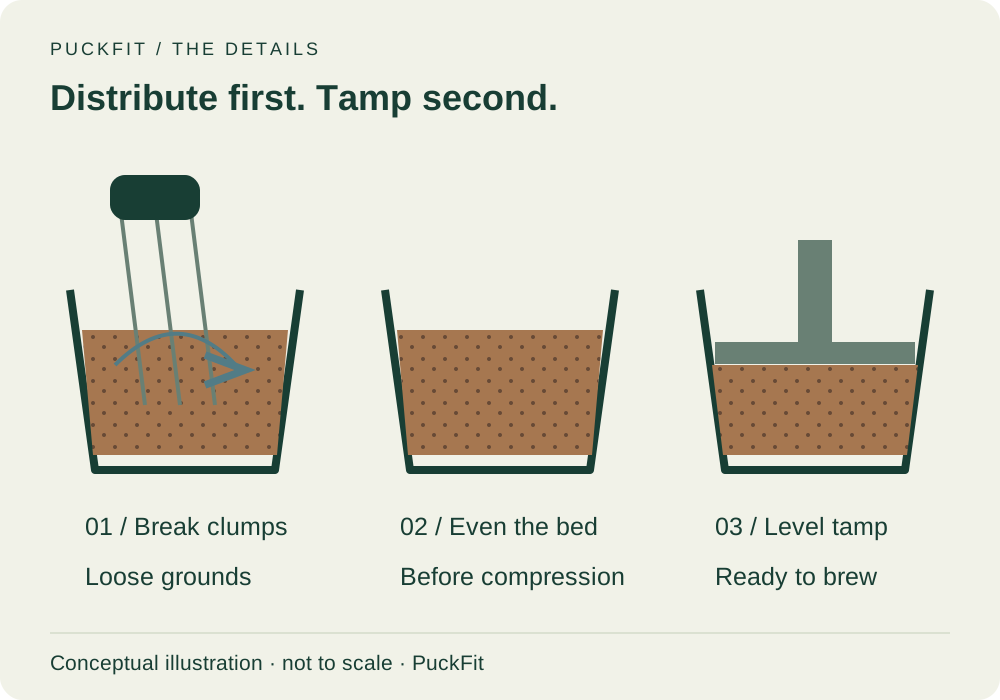
The preparation order
Dose → distribute → settle as needed → tamp → brew. WDT stands for Weiss Distribution Technique: stirring the loose coffee with a fine-needle tool. Barista Hustle describes it as a way of breaking clumps and evening out the bed. Its distribution lesson distinguishes work through the coffee from merely smoothing the visible surface.
Treat this as a preparation step, not a decoration applied after compression. If you put needles through an already tamped puck, you have changed the bed that you were about to brew. For a clean comparison, begin the routine again rather than trying to preserve the appearance of the first tamp.
Try a consistent sequence
- Weigh the coffee dose. Keep the basket, beans and grind setting the same while comparing distribution methods. A different dose makes the comparison harder to interpret.
- Use a compatible funnel if helpful. Its purpose is to keep loose grounds inside the basket while you work. Check that it sits securely and does not obstruct the tool.
- Work gently through the grounds. Reach the coffee below the surface without scraping the basket or bending the needles. Move around the basket rather than repeatedly stirring one spot.
- Finish near the surface. Leave the coffee reasonably even so the next step is easy to inspect. Avoid chasing a perfectly polished appearance.
- Remove the funnel and tamp level. Some funnels are designed for tamp-through use, but do not assume yours is. Check its instructions and the tamper's clearance.
This is PuckFit's suggested workflow for comparison. The best reason to keep a step is that it helps your routine produce the cups you want with manageable effort. A longer ritual is not automatically more useful.
How to compare WDT with your current routine
Choose one question: for example, “does this reduce visible spraying while I keep the recipe fixed?” Record the dose, beverage weight, approximate duration and a taste note for your normal method. Then repeat with the distribution step changed. If other settings moved too, mark that comparison as inconclusive rather than crediting the new tool.
| Keep fixed | Record |
|---|---|
| Beans, basket and grind setting | How the grounds look before tamping. |
| Measured dose and target beverage weight | Shot duration and visible flow behavior. |
| Tamper and pressing routine | Taste and preparation time. |
Do you need a distributor and a new tamper?
Identify the job before adding equipment. A needle tool addresses loose-ground distribution; a tamper compresses the prepared bed. A spinning surface-leveling tool is another design and should not be assumed to perform the same action through the full depth.
If you are deciding between accessories, prioritize the limitation you can actually observe. The tamper upgrade guide helps with fit, comfort and feature preferences, while the spraying checklist separates uneven flow from rim leaks. Neither requires buying several tools at once.
Does a smooth-looking top prove the coffee is evenly distributed?
No. The surface is only what you can see. Distribution throughout the loose bed and surface appearance are different observations.
Will WDT guarantee a higher extraction or better taste?
No result is guaranteed for your setup. Compare the same recipe and judge repeatability and taste. PuckFit has not performed a controlled test of a particular tool.
Sources and scope
The sources below support the technical explanations. Checklists and buying decisions are PuckFit's editorial guidance. Illustrations explain concepts and are not product test photographs.
- Barista Hustle: Weiss Distribution Technique (editorial source · non-affiliate) — checked 10 November 2026.
- Barista Hustle: distribution techniques (editorial source · non-affiliate) — checked 10 November 2026.